A reliable laptop power bank can keep your computer working through delayed flights, long commutes, crowded cafés, and power outages. The best options combine enough watt-hours for useful runtime with USB-C Power Delivery output that matches your laptop’s charging needs.
This roundup compares 10 laptop-ready battery packs, from compact 100W USB-C chargers to larger models with AC outlets, multiple ports, high total output, and LiFePO4 battery chemistry.
Best 10 Power Banks for Laptops Picks for 2026
Top Powerhouse
Anker Prime 26K 300W Power Bank

- 300W total output with up to 140W from USB-C
- 250W dual-input recharge reaches 50% in 13 minutes
- Digital display and app-based output control
Best For: High-output MacBook Pro charging and fast travel recharging
Best Cable Convenience

- 200W output with 100W available per USB-C port
- Built-in retractable USB-C and strap cables
- 90Wh airline-friendly capacity with TFT display
Best For: Business travel with fewer loose cables
Best Multi-Device Design
Anker 25K 165W Travel Power Bank

- Three 100W USB-C ports and four total connections
- Two built-in cables reduce packing clutter
- 25,000mAh capacity meets stated 100Wh airline limit
Best For: Charging a laptop, phone, tablet, and other USB devices together
Best Compact Option
UGREEN Nexode 20K 130W Power Bank

- 100W primary output and 130W total output
- TFT display provides detailed charging information
- 20,000mAh, 72Wh airline-approved capacity
Best For: Light travel and commuting with a laptop
Best Travel Pick
Compact 100W Laptop Power Bank

- 100W output for compatible laptops and handheld consoles
- 25,000mAh airline-safe capacity
- Three ports with detachable USB-C cable
Best For: Travelers and multi-device users needing fast backup power
Best High-Output Pick

- Up to 140W from one USB-C port
- 25,000mAh capacity for laptop and mobile recharging
- Two-way charging and digital battery display
Best For: High-performance USB-C laptops and demanding travel setups
Best Outdoor Pick

- AC outlets plus USB and DC outputs
- 100W output with 89.6Wh LiFePO4 battery
- Fanless design, flashlight, and 3,500+ rated cycles
Best For: Camping, outages, and laptop charging with AC flexibility
Best AC-Outlet Value
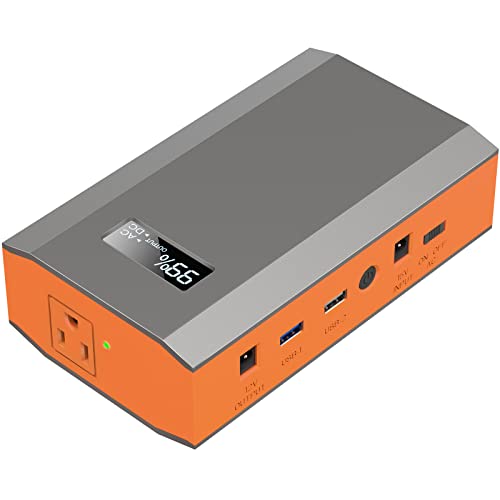
- 65W AC outlet for compatible laptops
- USB, QC USB, and DC charging ports
- Wall, car, or solar-panel recharging
Best For: Camping, RV use, outages, and low-wattage laptop charging
Best Slim Travel Pick

- 100W USB-C PD fast charging
- Slim design for bags and briefcases
- 20,000mAh capacity with digital display
Best For: USB-C laptop charging during flights, commutes, and business travel
Best High-Capacity AC Option

- 100W AC outlet for compatible devices
- 65W USB-C PD input and output
- 27,000mAh capacity with four ports
Best For: Travel, outdoor use, and emergency backup with AC flexibility
Top Powerhouse – Anker Prime 26K 300W Power Bank
For shoppers comparing power banks for laptops, the Anker Prime stands out with 300W total output and up to 140W from a USB-C port. Its 26,250mAh capacity, detailed display, and fast 250W dual-USB-C recharge make it well suited to demanding travel and mobile work setups.
Best For: MacBook Pro users who need high output for multiple devices and very fast power-bank recharge times.
Pros:
- 300W total output across two USB-C ports and one USB-A port.
- Up to 140W laptop charging with a compatible 5A cable.
- 250W dual-input recharge can reach 50% in 13 minutes under stated testing conditions.
- Digital display and app control provide detailed charging information.
Cons:
- Its 600g weight and larger form factor may be less convenient for light packing.
- MacBook Pro (M4) charging is listed as up to 0.8 times, so it is not a full replacement for a wall charger on long trips.
- Not compatible with Starlink Mini.
This is the most performance-focused option in the group. Choose it when maximum laptop output and rapid turnaround matter more than minimizing weight.
Best Cable Convenience – UGREEN Nexode Pro 25K 200W
The UGREEN Nexode Pro is one of the more travel-friendly power banks for laptops, combining 200W output with built-in retractable USB-C cables. Its 25,000mAh capacity, 90Wh airline-friendly rating, and TFT display make it a practical choice for business trips.
Best For: Travelers who want strong laptop charging without packing separate USB-C cables.
Pros:
- Up to 200W total output and 100W per USB-C port.
- Built-in 26.7-inch retractable USB-C cable supports 100W input and output.
- Additional integrated strap cable adds carrying convenience.
- TFT display shows output wattage, battery health, cycles, and estimated time remaining.
Cons:
- The supplied details list one USB-C connector type and do not describe a USB-A port.
- At 6.22 by 2.13 by 1.97 inches, it is relatively substantial for a compact travel charger.
- The warranty is listed as one year.
Its integrated cables are the main reason to choose this model. It offers substantial laptop power while reducing cable clutter in a work bag.
Best Multi-Device Design – Anker 25K 165W Travel Power Bank
If you need power banks for laptops that can also handle phones and tablets, this Anker model offers three 100W USB-C ports, four total charging connections, and a 25,000mAh capacity. Its built-in and retractable cables are useful for commuting, remote work, and family travel.
Best For: Users charging a laptop alongside several personal devices without carrying multiple cables.
Pros:
- Three 100W USB-C ports support simultaneous multi-device charging.
- Four charging connections include USB-C cables, USB-C, and USB-A options.
- Two built-in cables simplify travel and double as a carrying strap.
- 25,000mAh capacity complies with stated 100Wh airline carry-on restrictions.
Cons:
- A wall charger is not included.
- The listed 165W total output is lower than the 200W and 300W options in this roundup.
- Its built-in cable layout may be more than needed for users charging only one device.
This is a versatile middle ground: it emphasizes connection flexibility and convenience rather than the highest total output. It is especially useful for mobile workstations with several USB devices.
Best Compact Option – UGREEN Nexode 20K 130W Power Bank
The UGREEN Nexode 20K is a compact choice among power banks for laptops, with up to 100W output from its primary port and 130W total output. It combines a 20,000mAh battery with a TFT display, airline-friendly capacity, and a column-shaped design intended for easier handling.
Best For: Commuters and light travelers who want laptop charging in a smaller, lighter package.
Pros:
- 100W fast charging can power a MacBook Pro 16-inch to 43% in 30 minutes under stated testing conditions.
- 130W total output supports charging multiple devices.
- TFT display shows battery, remaining time, input/output power, voltage, and current.
- 20,000mAh, 72Wh capacity is described as airline approved.
Cons:
- Its 20,000mAh capacity is lower than the 25,000mAh and 26,250mAh alternatives.
- Best performance depends on using the included 5A USB-C cable.
- The supplied details do not provide complete dimensions.
This model makes sense when portability matters more than maximum runtime. Its display and 100W primary output cover many MacBook and Chromebook use cases while keeping the capacity below the 100Wh airline threshold.
Best Travel Pick – Compact 100W Laptop Power Bank
For travelers comparing power banks for laptops, the INIU 25000mAh pack combines 100W output with a relatively compact design. It can fast-charge compatible laptops, phones, tablets, cameras, drones, and handheld consoles, while its digital display helps you monitor remaining power.
Best For: Business travelers, remote workers, students, creators, gamers, and anyone carrying several devices.
Pros:
- 100W output supports compatible laptops and demanding devices such as Steam Deck, ROG Ally, and Legion Go.
- 25,000mAh airline-safe capacity provides substantial backup power for travel days.
- Three ports—two USB-C and one USB-A—support simultaneous charging.
- Detachable 100W USB-C cable and a 3-year warranty add practical convenience.
Cons:
- At approximately 14 ounces, it is compact but not lightweight compared with smaller phone-focused banks.
- Older iPhones using Lightning require a separate compatible cable.
This is a well-rounded choice when you want one travel-friendly battery for a laptop and multiple personal or creative devices, especially where fast charging and portability matter.
Best High-Output Pick – 140W Laptop Power Bank
The UGREEN Nexode stands out among power banks for laptops with a 140W single-port output and a 25,000mAh capacity. Its PD 3.1 support is suited to compatible high-performance laptops, while the display and three-port layout make it useful for mixed-device charging.
Best For: MacBook users, professionals with power-hungry laptops, and travelers who want high output plus phone and tablet charging.
Pros:
- USB-C1 can deliver up to 140W and is rated to charge a 16-inch MacBook Pro from 0% to 56% in 30 minutes.
- 25,000mAh capacity can recharge laptops up to 1.3 times, according to the supplied specifications.
- Two USB-C ports and one USB-A port support several devices.
- Two-way fast charging can recharge the bank in about two hours with a 65W charger.
Cons:
- The 65W charging adapter needed for approximately two-hour recharging is not included.
- Full performance requires the included 5A cable or another certified 5A cable.
If your laptop benefits from high-wattage USB-C charging, this is the strongest performance-oriented option in the group. Confirm your laptop’s input requirements before buying to take advantage of the 140W output.
Best Outdoor Pick – LiFePO4 Laptop Power Station
For shoppers who need more than a conventional battery pack, this Daran power station adds AC outlets, DC output, and USB charging. Its 89.6Wh LiFePO4 battery and 100W output make it a practical option for compatible laptops, camping, outages, and other situations where a broader range of connections is useful.
Best For: Campers, emergency-preparedness users, remote workers, and anyone needing AC as well as USB-C laptop charging.
Pros:
- Offers seven outputs, including two 100W AC outlets, USB-C, USB-A, and DC5521 ports.
- LiFePO4 battery is rated for more than 3,500 cycles and includes 12 safety protections.
- Can recharge from 0% to 80% in about 1.5 hours using its fast-charging method.
- Fanless operation, a digital display, and a flashlight suit quiet indoor or outdoor use.
Cons:
- Its maximum output is 100W, so it is less suitable for laptops requiring more power.
- The solar panel and charging cable are not included.
- At 2.54 pounds, it is substantially heavier than a pocket-sized laptop power bank.
This model makes the most sense when versatility and battery durability outweigh minimal weight. Choose it over a standard power bank if AC outlets, emergency lighting, or camping-oriented features are part of your plan.
Best AC-Outlet Value – 65W Portable Laptop Charger
If you need power banks for laptops that can also run small AC-powered devices, this compact ZeroKor unit offers a 65W AC outlet alongside USB and DC outputs. Its portable design suits camping, RV trips, outages, and other situations where a wall outlet is unavailable.
Best For: Outdoor users who need an AC outlet, multiple charging ports, and several recharge options in a relatively compact power bank.
Pros:
- 65W AC outlet can power compatible laptops and other devices.
- Includes USB, QC USB, and DC outputs for charging multiple devices.
- Can recharge from a wall outlet, car adapter, or compatible solar panel.
- Built-in flashlight includes reading and SOS modes.
Cons:
- AC output must be turned on or off manually.
- Devices must stay within the 65W limit.
- Solar panel is not included.
This is a practical choice when versatility matters more than maximum laptop wattage. Check your laptop’s running power before buying, since higher-demand models may exceed its output limit.
Best Slim Travel Pick – Baseus 100W Laptop Power Bank
For travelers comparing power banks for laptops, the Baseus Blade emphasizes fast USB-C charging in a flat, briefcase-friendly design. Its 100W USB-C PD output is suited to compatible MacBook, Windows laptop, tablet, phone, and handheld gaming-device users.
Best For: Business travelers and commuters who want a slim, high-output USB-C power bank with enough capacity for extended trips.
Pros:
- 100W USB-C PD output can charge a MacBook Pro to 50% in about 30 minutes, according to the supplied notes.
- Four ports include two USB-C and two USB-A connections.
- 20,000mAh capacity is specified to provide 70% or more battery for many 13–15-inch laptops.
- Digital display shows remaining power, and a USB-C cable is included.
Cons:
- It provides USB charging rather than an AC wall-style outlet.
- Actual laptop runtime varies by device and usage.
- The flat design is still relatively substantial at about 451g.
Choose this model if your laptop supports USB-C charging and you value portability, fast output, and clear battery-level tracking. It is less suitable for laptops that require a conventional AC adapter.
Best High-Capacity AC Option – 100W Laptop Charger
This Paopaoyu model is one of the more versatile power banks for laptops, combining a 100W AC outlet with a 65W USB-C PD port and additional USB outputs. Its 98Wh capacity is designed for travel, outdoor activities, and emergency backup while remaining under the stated 100Wh airline threshold.
Best For: Travelers and emergency-preparedness users who want higher capacity, AC compatibility, and fast USB-C charging in one unit.
Pros:
- 100W AC outlet supports compatible appliances and laptops below the rated limit.
- 65W USB-C PD port handles both input and output and can fully recharge the unit in about 1.5 hours, according to the notes.
- 27,000mAh capacity and four output ports support laptops, phones, tablets, and cameras.
- Listed certifications and multiple protection systems address overcharging, over-voltage, over-current, and short circuits.
Cons:
- AC-connected devices must remain below 100W.
- The unit is larger than slim USB-only power banks.
- Its warranty is listed as one year.
With both AC and USB-C outputs, this is a strong middle ground for users who need more flexibility than a standard laptop power bank. Confirm your laptop’s power requirements and remember that high-draw appliances may trigger protection mode.
How We Picked These Power Banks for Laptops
We focused on capacity, charging output, portability, connection options, and practical travel use. Every selected model is positioned for laptop charging, but the designs vary considerably: some prioritize compact USB-C power, while others add AC outlets for devices that do not charge directly over USB-C.
We also considered port layouts, multi-device charging, stated watt-hour capacity, peak output, integrated cables, and features that affect everyday convenience. Product specifications can vary by configuration, so confirm the manufacturer’s current ratings before buying.
Quick Comparison
| Type | Best For | What to Look For |
|---|---|---|
| 100W USB-C power bank | Ultrabooks and everyday laptops | USB-C PD, compact size, adequate capacity |
| 130W–200W multi-port bank | Power users and multiple devices | Total output, per-port limits, thermal management |
| 250W–300W high-output bank | Demanding laptops and several devices | Large capacity, weight, airline restrictions |
| AC-outlet power bank | Laptops, chargers, and AC accessories | Continuous wattage, inverter efficiency, outlet safety |
| Portable power station | Emergency backup and off-grid use | Battery chemistry, outlets, recharge options |
Key Buying Factors for Power Banks for Laptops
Output Wattage and USB-C PD
Check your laptop charger’s wattage, then choose a power bank that meets or exceeds it. A 65W or 100W USB-C PD output is suitable for many ultraportables, while gaming laptops and workstation-class systems may need substantially more. If you charge several devices simultaneously, check the output available on each port rather than relying only on the headline total.
Capacity and Usable Runtime
Higher mAh ratings generally mean more stored energy, but watt-hours provide a more useful comparison across products. Real-world output is lower than the advertised battery capacity because of voltage conversion and charging losses. Larger batteries also tend to weigh more, so balance runtime against portability.
Ports, Cables, and Compatibility
USB-C ports with Power Delivery are usually the simplest choice for modern laptops. Built-in retractable cables can reduce clutter, while multiple USB-C and USB-A ports help charge phones, tablets, headphones, or accessories. For older laptops, verify whether the included cable and output protocol are compatible.
AC Outlets and Travel Limits
An AC outlet adds flexibility but usually increases size, weight, and conversion losses. Confirm continuous—not just peak—wattage before connecting a laptop. For air travel, check the battery’s stated watt-hours and current airline rules; many high-capacity models cannot be carried in standard cabin luggage.
Who Should Buy Which Power Banks for Laptops?
Choose a compact 100W model if you carry an ultrabook and want a practical commuter backup. Pick a 130W to 200W multi-port bank if you regularly charge a laptop, phone, and tablet together. A 250W or 300W model suits demanding workloads and multiple devices when extra weight is acceptable.
Choose an AC-outlet model for laptops or accessories that lack USB-C charging. For outages, camping, or extended off-grid use, a portable power station with a larger battery and additional recharge options is the more versatile choice. Whichever type you select, match the output to your laptop first, then compare capacity, size, and travel practicality.