A laptop screen extender can add valuable display space without requiring a full desktop monitor setup. The best models balance clear resolution, reliable connectivity, portability, and a secure fit across common laptop sizes.
We compared 10 laptop screen extenders under $300 for work, travel, presentations, and multitasking. Use the guide below to narrow your choices by screen size, weight, connection needs, and intended use.
Best 10 Laptop Screen Extenders Under 300 Picks for 2026
Best Adjustable Setup
Anyking 15.6-inch Detachable Monitor Extender

- FHD IPS display with 330 cd/m² brightness
- Adjustable stand with 90-degree rotation
- Supports VESA mounting and five display modes
Best For: Flexible desk, travel, and presentation setups
Best Lightweight Choice
Blackview SCM6 14-inch Laptop Monitor Extender

- Weighs 1.3 pounds and is 0.17 inches thick
- FHD IPS display with 100% sRGB coverage
- Includes TÜV SÜD-certified blue-light filtering
Best For: Frequent travel and lightweight mobile work
Best for Easy Setup
Lightweight 14-Inch Triple Extender

- Triple-screen modes for intensive multitasking
- FHD IPS panel with 100% sRGB coverage
- Adjustable stand and broad cable compatibility
Best For: Mobile professionals who need three displays
Best for Everyday Use
14.2-Inch Ultra-Portable Extender

- Weighs just 1.87 pounds
- 1080p IPS display with 300-nit brightness
- USB-C or HDMI/USB-A plug-and-play setup
Best For: Travelers who want a lighter dual-screen setup
Best Large-Display Pick

- Large FHD IPS screen for comfortable multitasking
- Detachable design supports standalone monitor use
- 360-degree rotation and built-in speakers
Best For: Users wanting a larger, flexible second display
Best Lightweight Triple-Screen Pick
Synnov 15.6-inch Laptop Screen Extender

- 15.6-inch 1080p IPS display
- Lightweight aluminum build and carry bag
- Supports extended, mirrored, and portrait modes
Best For: Traveling professionals and remote workers
Best Cable-Simplifying Option
ZUMWALT P7 15.6-inch Triple Monitor
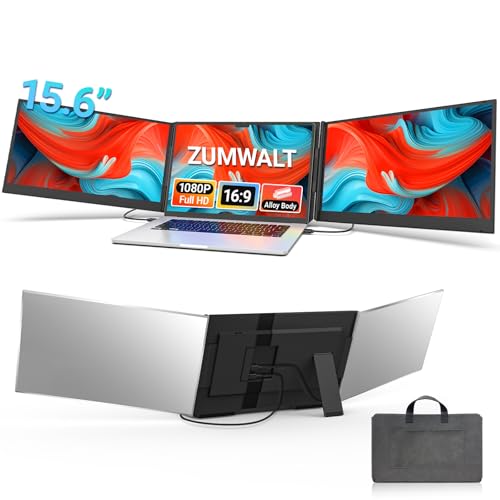
- Two 15.6-inch 1080p external displays
- Simple two-USB-C setup on supported laptops
- Includes cables, adapter, and carrying bag
Best For: Professionals needing a large portable workspace
Best Triple-Screen Pick – KEFEYA 15.6-inch FHD Triple Monitor Extender
For shoppers comparing laptop screen extenders under 300, the KEFEYA stands out with two additional 15.6-inch FHD IPS displays for a three-screen setup. Its foldable design, included carrying case, and multiple viewing modes make it practical for mobile multitasking, though compatibility should be checked carefully.
Best For: Remote workers, programmers, stock traders, and anyone who wants a portable triple-screen workstation.
Pros:
- Two 15.6-inch 1920×1080 IPS displays create a triple-screen workspace.
- Foldable 0.16-inch-thin design includes a leather carrying bag.
- Supports mirror, extension, landscape, portrait, and 180-degree rotation modes.
- Includes USB-C, HDMI-to-USB-C, and USB-C-to-USB-A cables.
Cons:
- Not directly compatible with Mac M1, M2, or M3 chips without a separate adapter.
- The 3.9-pound weight is substantial for frequent carry.
- USB-A to USB-C supports power only.
The KEFEYA offers the most expansive workspace in this group, with vivid FHD resolution and flexible positioning. It is a strong choice when three simultaneous screens matter more than minimizing travel weight.
Best Adjustable Setup – Anyking 15.6-inch Detachable Monitor Extender
Among laptop screen extenders under 300, this Anyking model is notable for its adjustable stand and broad positioning options. It combines a 15.6-inch FHD IPS panel with landscape, portrait, mirrored, extended, and rotated modes, making it adaptable for work and entertainment.
Best For: Users who want height adjustment, screen rotation, and the option to use a VESA-mounted setup.
Pros:
- 15.6-inch FHD IPS display offers 330 cd/m² brightness and a 60Hz refresh rate.
- Built-in stand supports flexible height adjustment and 90-degree rotation.
- Supports five display modes and 75x75mm VESA mounting.
- One-cable setup is available through a full-featured USB-C port.
Cons:
- HDMI connections require a separate USB-A power connection.
- Compatibility depends on having the appropriate video-capable port.
- The supplied notes do not specify the product’s weight.
The Anyking is a flexible middle-ground option for buyers who value adjustability over the lightest possible design. Its stand and VESA support give it more placement options than a basic clip-on extender.
Best Lightweight Choice – Blackview SCM6 14-inch Laptop Monitor Extender
If portability is the priority when shopping for laptop screen extenders under 300, the Blackview SCM6 is especially appealing. It weighs just 1.3 pounds and measures 0.17 inches thick while providing a 14.1-inch FHD IPS display for a lighter dual-monitor travel setup.
Best For: Frequent travelers and mobile professionals who want a second screen without adding much weight.
Pros:
- Ultra-light 1.3-pound, 0.17-inch-thin design is easy to carry.
- 14.1-inch 1920×1080 display offers 300 nits brightness and 100% sRGB coverage.
- Hardware-level blue-light filtering has TÜV SÜD certification.
- Includes cables, a protective case, and a stated 24-month warranty.
Cons:
- The 14.1-inch screen is smaller than the 15.6-inch alternatives.
- Its glossy finish may be less suitable for bright environments than a matte display.
- HDMI use requires separate USB-C-to-USB-A power connection.
The SCM6 is the easiest model here to justify for frequent travel because its low weight and slim profile reduce carrying bulk. Choose it when mobility and eye-comfort features matter more than maximum screen size.
Best Flexible Triple-Screen Design – 15.6-inch Detachable FHD Extender
This detachable 15.6-inch model is a versatile contender among laptop screen extenders under 300, offering a triple-screen layout with unusually broad rotation. Its two sides can also be separated for independent use, giving travelers more ways to configure or share the displays.
Best For: Multitaskers who need flexible landscape, portrait, stacked, or detachable screen arrangements.
Pros:
- 235-degree horizontal and 90-degree vertical rotation support varied layouts.
- Detachable design allows each side to be used independently at 2.1 pounds per side.
- 15.6-inch FHD IPS panels include built-in speakers, low-blue-light, anti-glare, and flicker-free features.
- Supports USB-C, USB-A, and HDMI connections without driver installation.
Cons:
- Mac M1, M2, and M3 chip compatibility is limited; specified Pro and Max versions are supported.
- HDMI use requires an additional USB-A-to-USB-C power cable.
- The glossy screen finish may reflect surrounding light.
The standout feature is configurability: this extender can function as a triple-screen workstation, a stacked setup, or separate displays. It is a strong fit for users willing to trade some simplicity for more layout and sharing options.
Best for Easy Setup – Lightweight 14-Inch Triple Extender
If you need laptop screen extenders under 300 for demanding multitasking, this 14-inch triple-screen model adds substantial workspace while remaining travel-friendly. Its FHD IPS display, adjustable stand, and included connection cables suit mobile offices and multi-window workflows.
Best For: Traders, developers, designers, and remote workers who want a portable triple-screen setup.
Pros:
- Adds triple-screen capability with extended, mirrored, and portrait modes.
- FHD 1920×1080 IPS display with 300-nit brightness and 100% sRGB coverage.
- Compact 0.3-inch-thin design, adjustable stand, and 180-degree horizontal rotation.
- Includes USB-C, USB-C-to-USB-A, and HDMI cables for flexible setup.
Cons:
- At 3.0 pounds, it is heavier than the other options in this roundup.
- M1/M2/M3 MacBooks support only one screen without a DisplayLink adapter.
- Some setups may require a separate 5V/3A-or-higher power adapter for stable brightness.
This is the most productivity-focused choice here, especially if three displays matter more than minimizing travel weight. Check your laptop ports and operating system before buying, particularly if you use an M-series MacBook.
Best for Everyday Use – 14.2-Inch Ultra-Portable Extender
Among laptop screen extenders under 300, this 14.2-inch dual monitor stands out for its 1.87-pound weight and slim 0.27-inch profile. It offers a straightforward way to add a second display for travel, studying, meetings, and everyday multitasking.
Best For: Frequent travelers, students, remote workers, and programmers prioritizing low carry weight.
Pros:
- Lightweight 1.87-pound design fits 14- to 17.3-inch laptops.
- 1080p IPS display with 300-nit brightness and 60Hz refresh rate.
- Supports extended, mirrored, and portrait viewing modes.
- Works through USB-C or HDMI and USB-A connections without driver installation.
Cons:
- It provides one added screen rather than a triple-display arrangement.
- Compatibility depends on having a full-function USB-C port or the required HDMI and USB-A connections.
- The supplied details do not specify the full viewing-angle range.
This model is a practical balance for users who want extra screen space without a bulky travel setup. Its low weight makes it especially appealing for commuting and business trips, provided your laptop supports one of the listed connection methods.
Best Large-Display Pick – 15.6-Inch Detachable Extender
For shoppers comparing laptop screen extenders under 300, this 15.6-inch model offers a larger viewing area while retaining a foldable, travel-oriented design. Its detachable screen, rotating bracket, built-in speakers, and multiple display modes make it flexible for work and entertainment.
Best For: Users who prefer a larger secondary display that can also operate independently.
Pros:
- Large 15.6-inch FHD IPS display with 60Hz operation and high brightness.
- Detaches for use as an independent secondary monitor.
- 360-degree rotating bracket and 192-degree tilt support landscape or portrait use.
- Built-in speakers and included USB-C, USB-A-to-USB-C, and HDMI-to-Mini HDMI cables.
Cons:
- At 2.8 pounds, it is not the lightest option for frequent travel.
- Some connections may require an external 5V/2A power adapter for stable operation.
- The glossy finish may reflect more light than a matte screen.
This is the strongest fit if screen size and flexible placement matter more than minimum weight. The detachable design adds versatility, while the broad compatibility and included cables simplify setup across laptops and other supported devices.
Best Lightweight Triple-Screen Pick – Synnov 15.6-inch Laptop Screen Extender
If you are comparing laptop screen extenders under 300, the Synnov is a practical choice for users who want a large 15.6-inch FHD display without a bulky setup. It supports extended, mirrored, and portrait modes, and its plug-and-play design works across several operating systems.
Best For: Travelers, remote workers, developers, and anyone who wants a lightweight triple-screen workstation.
Pros:
- 15.6-inch 1080p IPS screen with a 178-degree viewing angle
- Thin, lightweight aluminum design with a protective carry bag
- Supports two full-featured USB-C connections or USB-C plus HDMI
- Includes cables, power adapter, and no-driver plug-and-play setup
Cons:
- Requires at least one full-featured USB-C port for the primary setup
- Not compatible with M1, M2, or M3 MacBooks because of chip limitations
- Glossy screen finish may reflect surrounding light
The Synnov combines a spacious display with a relatively portable 4-pound aluminum build. Check your laptop’s USB-C specifications before buying, especially if you use a newer MacBook.
Best Cable-Simplifying Option – ZUMWALT P7 15.6-inch Triple Monitor
Among laptop screen extenders under 300, the ZUMWALT P7 stands out for its simplified USB-C connection and dual 15.6-inch FHD screens. It is designed to create a triple-screen workspace while keeping the setup relatively clean and portable.
Best For: On-the-go professionals who want two large external displays and a streamlined cable setup.
Pros:
- Two 15.6-inch 1080p displays with 280-nit brightness
- Two USB-C cables can provide a simple setup on supported devices
- Aluminum shell, leather carrying bag, and no-clip design
- Supports extended, mirrored, portrait, and landscape viewing modes
Cons:
- Laptops without full-featured USB-C may require an H5-T cable and additional connections
- M1, M2, and M3 MacBooks require the alternate cable setup noted by the manufacturer
- At approximately 4 pounds, it is less lightweight than some smaller extenders
The ZUMWALT P7 is appealing if screen size and a tidy two-cable setup matter most. Compatibility is more involved for some laptops, so verify ports and cable requirements before ordering.
Best Ultraportable Dual-Display Pick – Macsecor 14-inch FHD Extender
For shoppers researching laptop screen extenders under 300, the Macsecor offers two compact 14-inch FHD screens in a 3-pound design. Its clamp-on backplate, built-in stand, and dual-line plug-and-play approach are aimed at users who prioritize portability and quick setup.
Best For: Frequent travelers, programmers, stock traders, and laptop users who want a lighter dual-display extender.
Pros:
- Two 14-inch 1080p IPS screens in an ultra-slim design
- Approximately 3 pounds with a built-in aluminum stand
- Supports extended, mirrored, portrait, and landscape modes
- Includes HDR, blue-light filtering, anti-glare technology, and 180-degree rotation
Cons:
- Laptops without full-featured USB-C and M1/M2/M3 MacBooks need an additional H5-T cable
- Its 14-inch displays provide less viewing area than 15.6-inch alternatives
- May need direct external power if the display shows no signal or is not bright enough
The Macsecor is the most travel-friendly option of these three based on its lighter 3-pound build and 14-inch panels. Its compatibility notes make checking your laptop’s ports especially important.
How We Picked the Best Laptop Screen Extenders Under 300
We focused on the features that matter most in a portable second- or third-screen setup: display resolution, panel size, weight, thickness, laptop compatibility, mounting flexibility, and connection method. Models with FHD 1080p screens generally offer a good balance of sharpness and power consumption, while IPS panels are preferable for more consistent color and viewing angles.
We also considered practical details such as detachable designs, rotation ranges, included cables, plug-and-play support, and whether a product is better suited to travel or a permanent desk. Because compatibility can vary by computer, buyers should verify their laptop’s USB-C video support, available ports, operating system, and screen-size range before ordering.
Quick Comparison
| Feature | What to Look For | Why It Matters |
|---|---|---|
| Screen size | 14 to 15.6 inches | Larger screens improve workspace; smaller models travel more easily. |
| Resolution | FHD 1080p | Provides readable text and detailed images for everyday work. |
| Weight | About 1.3 to 3 pounds | Lower weight reduces strain in a travel bag. |
| Connectivity | USB-C video, HDMI, or USB-A support | Determines whether the extender works with your laptop without adapters. |
| Configuration | Dual or triple display | Choose based on available desk space and multitasking needs. |
Key Buying Factors for Laptop Screen Extenders Under 300
Compatibility and Ports
Do not assume every USB-C port carries video. Check whether your laptop supports DisplayPort over USB-C, and determine whether the extender requires one cable or separate power and video connections. HDMI-equipped laptops may need additional cables or adapters.
Size, Weight, and Stability
A 15.6-inch extender offers more room for spreadsheets and side-by-side windows, but a 14-inch model may be easier to carry. Check the stated laptop-size range and hinge design so the screen sits securely without putting excessive pressure on the computer display.
Display Quality and Adjustability
FHD resolution is suitable for documents, browsing, coding, and video calls. Look for IPS construction when viewing angles matter, plus adjustable rotation if you frequently switch between landscape and portrait layouts.
Power and Travel Convenience
Portable monitors can draw significant power from the laptop. A model that uses a single USB-C cable is convenient, while dual-cable designs may provide more reliable brightness or compatibility. Confirm what cables are included and whether a carrying case is supplied.
Who Should Buy Which Laptop Screen Extenders Under 300?
Frequent travelers: Choose an ultra-light, slim 14-inch model with simple USB-C operation and a secure detachable design.
Office and spreadsheet users: A 15.6-inch FHD extender provides more usable space for documents, email, and reference windows.
Presentation and creative users: Prioritize IPS viewing angles, flexible rotation, and stable support for showing content to people nearby.
Maximum multitasking: Select a triple-screen configuration if your laptop, desk, and ports can support the extra display. Before buying, confirm operating-system support and the required number of video-capable connections.