A laptop screen extender can add valuable workspace without requiring a full-size monitor and stand. For small desks, the best models balance screen size, laptop compatibility, cable simplicity, and a compact footprint.
We selected 10 portable dual- and triple-screen options in 14- and 15.6-inch sizes, with features such as Full HD resolution, detachable panels, USB-C connectivity, and adjustable positioning.
Best 10 Laptop Screen Extenders for Small Desks Picks for 2026
Flexible FHD Pick
Funhill 14.1-inch Dual-Screen Extender

- 14.1-inch 1080p IPS display
- 280-degree rotation and portrait mode
- USB-C and HDMI connectivity
Best For: Flexible second-screen setups on compact desks
Adjustable Workspace Pick

- Bright 15.6-inch 1080p IPS display
- Adjustable stand with 90-degree rotation
- Supports VESA mounting and five modes
Best For: Flexible remote-work and home-office layouts
Lightest Triple-Screen Option

- 0.3-inch thin and 3.0 pounds
- 14-inch 1080p IPS with 100% sRGB
- Supports extended, mirrored, and portrait modes
Best For: Portable triple-screen workstations
Compact Dual-Screen Value

- Scratch-conscious zero-contact frame
- 14-inch 1080p IPS second monitor
- Folds through a 225° adjustment range
Best For: Compact dual-screen office and travel setups
Best Heavy-Duty Pick
ZUMWALT 15.6-inch Portable Extender
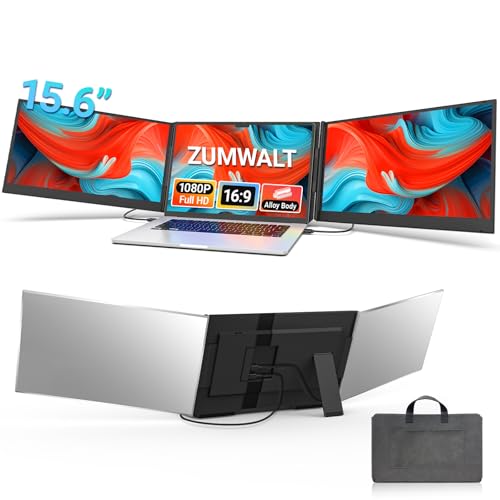
- Two 15.6-inch 1080p displays
- Creates a triple-screen setup
- Aluminum shell and carry bag included
Best For: Heavy multitasking and portable triple-screen workflows
Flexible FHD Pick – Funhill 14.1-inch Dual-Screen Extender
For shoppers comparing laptop screen extenders for small desks, the Funhill offers a compact 14.1-inch FHD workspace with flexible positioning. Its 280-degree rotation, matte IPS display, and USB-C or HDMI connectivity make it practical for home offices, travel, and multitasking.
Best For: Users who want a rotating, plug-and-play second screen that fits laptops from 13 to 17.3 inches.
Pros:
- 1920×1080 IPS display with a 60Hz refresh rate
- Supports extend, duplicate, and portrait display modes
- Includes USB-C, USB-A, HDMI, and adapter cables
- Works with a broad range of computers, phones, and consoles
Cons:
- USB-C connection requires a full-featured port with video support
- HDMI setups require a separate USB cable for power
The Funhill is a useful small-desk option when adjustability matters. Verify your laptop’s USB-C specifications before buying, especially if you want a one-cable setup.
Adjustable Workspace Pick – Anyking 15.6-inch Extender
The Anyking is a strong choice for laptop screen extenders for small desks when you want a larger panel without giving up positioning flexibility. Its built-in slide-rail stand, 90-degree rotation, and multiple display modes help tailor the setup for work, reading, coding, or entertainment.
Best For: Remote workers who want a larger FHD screen with height adjustment and optional VESA mounting.
Pros:
- 15.6-inch 1920×1080 IPS display with 330cd/m² brightness
- Supports landscape, portrait, extend, mirror, and rotated modes
- Built-in adjustable stand supports height and 90-degree rotation
- 75×75mm VESA mounting support adds setup flexibility
Cons:
- HDMI connections require a USB-A power cable
- The larger 15.6-inch format may be less compact than smaller extenders
Choose the Anyking if your small desk benefits from a screen that can be raised, rotated, or mounted. A full-featured USB-C port enables a simpler one-cable connection.
Triple-Screen Productivity Pick – KEFEYA 15.6-inch Triple-Screen Extender
The KEFEYA is designed for shoppers seeking laptop screen extenders for small desks that can create a full triple-screen workstation. It uses two 15.6-inch FHD IPS panels, folds for transport, and supports landscape, portrait, mirror, and extended modes for multitasking.
Best For: Professionals, programmers, traders, and other users who need two additional screens while traveling or working remotely.
Pros:
- Provides two 15.6-inch 1920×1080 IPS displays
- Ultra-thin 0.16-inch design with a foldable carrying setup
- Supports landscape, portrait, mirror, and extension modes
- Includes multiple USB-C, HDMI-to-USB-C, and power cables
Cons:
- At about 3.9 pounds, it is heavier than a single-screen extender
- Mac M1, M2, and M3 systems require a separate H6 adapter
- USB-A to USB-C cable is for power supply only
The KEFEYA maximizes screen area, but its two-panel design needs more room and cable management than a single extender. Check your laptop’s ports and operating-system compatibility before purchase.
Lightweight Travel Pick – DZVW 14-inch Laptop Extender
For small desks and mobile workstations, the DZVW keeps the footprint and weight relatively modest while adding a 14-inch FHD screen. This laptop screen extender supports USB-C or HDMI connections, several display modes, and laptops measuring approximately 11.81 to 16.14 inches in screen length.
Best For: Travelers, students, and remote workers who prioritize portability and quick setup.
Pros:
- 14-inch 1920×1080 IPS display with 300-nit brightness
- Supports extend, mirror, and portrait modes
- Weighs about 1.8 pounds and includes a securing side clip
- Works with Windows, macOS, ChromeOS, Linux, and Android
Cons:
- 63% sRGB gamut is more modest than some competing displays
- HDMI setups require both HDMI and USB-A connections
The DZVW is a practical pick when a portable, uncomplicated second screen matters more than maximum color coverage. Confirm your laptop’s screen length and port configuration for the best fit.
Most Flexible Triple-Screen Pick – 15.6" 1080p Detachable Triple Extender
For shoppers comparing laptop screen extenders for small desks, this model packs two detachable 15.6-inch FHD screens into a flexible triple-monitor setup. Its rotating stand and multiple connection options make it useful when you need more workspace without adding separate full-size monitors.
Best For: Users who want a versatile triple-screen setup for multitasking, presentations, or travel.
Pros:
- 235° horizontal and 90° vertical rotation supports landscape, portrait, and stacked layouts.
- Detachable screens can be used independently, with each side weighing 2.1 pounds.
- 15.6-inch 1080p IPS displays include anti-glare, flicker-free, low-blue-light features, and built-in speakers.
- Supports USB-C, USB-A, and HDMI connections without requiring drivers.
Cons:
- HDMI use requires an additional USB-A-to-USB-C cable for power.
- Compatibility with Apple silicon is limited to M1 Pro/Max, M2 Pro/Max, and M3 Pro/Max models; base M1, M2, and M3 chips are not supported.
- The larger 15.6-inch screens may be less space-efficient than smaller extenders on very narrow desks.
This is the strongest choice if flexibility matters more than minimizing size. The detachable design and broad positioning options help adapt a compact workstation for focused work, collaboration, or presentations.
Lightest Triple-Screen Option – 14" Ultra-Thin FHD Extender
Among laptop screen extenders for small desks, this 14-inch model emphasizes a thin, travel-ready design while still creating a triple-screen workstation. Its adjustable stand and 3.0-pound total weight suit compact home offices, cafés, campus setups, and business travel.
Best For: Remote workers, students, and travelers who want triple-screen productivity with less bulk.
Pros:
- Ultra-thin 0.3-inch body and 3.0-pound weight are designed for portability.
- 14-inch 1920×1080 IPS display offers 300-nit brightness, 100% sRGB coverage, anti-glare treatment, and eye-care features.
- Supports extended, mirrored, and portrait display modes.
- Includes USB-C, USB-C-to-USB-A, and HDMI cables for plug-and-play setup.
Cons:
- MacBook M1, M2, and M3 models support only a single screen without a DisplayLink adapter.
- A separate 5V/3A-or-higher power adapter may be needed if the display flickers or appears dim.
- The 178° viewing angle is narrower than the 235° rotation range offered by some competing designs.
This model balances screen expansion and desk efficiency particularly well. Choose it when a slim triple-screen setup and easy portability are more important than using the largest available panels.
Compact Dual-Screen Value – APILDELLA 14" FHD Extender
This APILDELLA model is a practical choice for shoppers seeking laptop screen extenders for small desks without moving to a triple-screen setup. The 14-inch second display adds room for email, reference material, or coding while its adjustable support is designed for 13- to 16-inch laptops.
Best For: Users who need a compact second screen for office work, remote collaboration, and business travel.
Pros:
- Zero-contact frame is designed to help protect the laptop screen from scratches.
- 14-inch 1920×1080 IPS display supports extend and mirror modes.
- Folding angle adjusts from 0° to 225° for positioning on a compact desk.
- Includes USB-C, USB-A, and HDMI cables and works with Mac, Windows, Android, and most 13- to 16-inch laptops.
Cons:
- The 250-candela-per-square-meter brightness is lower than the 300-nit ratings listed for the other products.
- It is a dual-screen extender rather than a triple-screen solution.
- Depending on the connection, it may need external power or a specific cable configuration to resolve low brightness or no-signal issues.
For a small desk, this is the simplest of the three ways to add usable screen space without committing to a triple-monitor attachment. Its protective frame, broad laptop-size range, and 225° folding adjustment make it a sensible compact second-screen pick.
Flexible FHD Workspace – FLYTOCCA 15.6-inch Laptop Screen Extender
For shoppers comparing laptop screen extenders for small desks, the FLYTOCCA stands out with a detachable 15.6-inch FHD display that adds workspace without requiring a separate desktop monitor. Its vertical-mount option and one-cable USB-C setup make it adaptable for compact work areas, coding, documents, and travel.
Best For: Users who want a larger single add-on screen with flexible horizontal or vertical positioning.
Pros:
- 15.6-inch 1920×1080 IPS display provides more viewing space than a typical 14-inch monitor.
- Detachable screen supports vertical mounting for coding, long documents, and vertical content.
- Fits 13-inch to 17.3-inch laptops and folds down for easier transport.
- Supports one-cable USB-C connection, with USB-A and HDMI options for compatible laptops.
Cons:
- USB-C one-cable operation requires a full-function USB-C port.
- At 1.5 pounds, it may add noticeable weight to a highly portable setup.
The FLYTOCCA is a practical choice when a small desk needs extra screen area but not a permanent monitor stand. Its detachable design, vertical mode, and broad laptop-size compatibility give it more placement flexibility than a fixed extender.
Best Heavy-Duty Pick – ZUMWALT 15.6-inch Portable Extender
Among laptop screen extenders for small desks, the ZUMWALT P7 is aimed at users who want a full triple-screen arrangement without adding a conventional monitor and stand. It includes two 15.6-inch 1080p displays, streamlined USB-C connectivity, and a carrying bag for portable workstations.
Best For: Multitaskers who need two additional screens for work, presentations, or coding.
Pros:
- Two 15.6-inch 1080p displays can expand a laptop into a triple-screen workspace.
- Two USB-C cables can simplify setup when the laptop supports full-function USB-C.
- Aluminum-alloy construction, a slim profile, and included carrying bag support travel use.
- Supports extended, mirrored, and portrait display modes.
Cons:
- Weighs about 4 pounds, making it substantially heavier than a single-screen extender.
- M1/M2/M3 MacBooks and laptops without full-function USB-C may require an additional H5-T cable and more involved setup.
The ZUMWALT offers the most screen real estate of these options, but its dual-panel design takes more effort to carry and may involve extra cables for some devices. It is best suited to users who value maximum multitasking space over minimum weight.
Lightweight Eye-Comfort Pick – Blackview 14-inch Screen Extender
For small desks and mobile work, the Blackview 14-inch extender balances added screen space with a lighter 1.97-pound design. Its 1080p display, adjustable stand, silicone-lined mounting pads, and TÜV SÜD eye-comfort features make it a practical option for frequent travel and long work sessions.
Best For: Mobile professionals who want a lightweight second screen with eye-comfort features.
Pros:
- 14-inch 1080p display offers 300-nit brightness and a wide 180-degree viewing angle.
- TÜV SÜD-certified low-blue-light and flicker-free features are designed to support viewing comfort.
- Weighs 1.97 pounds and uses a 90-degree adjustable stand for portable setups.
- Fits 13-inch to 17.3-inch laptops and supports USB-C or HDMI with USB-A power.
Cons:
- The 14-inch screen is smaller than the 15.6-inch displays in the other listed options.
- Its glossy finish may be less suitable for users who prefer matte screens.
The Blackview is a strong compact choice when portability and viewing comfort matter more than maximum screen size. Its broad device compatibility and multiple display modes add flexibility for office, travel, and small-desk use.
How We Picked the Best Laptop Screen Extenders for Small Desks
We focused on portable monitor extenders that add practical screen space while keeping desk clutter under control. The selection includes 14-inch and 15.6-inch models suited to common 13- to 17.3-inch laptops, along with lightweight designs for travel and flexible setups.
Our comparison emphasized display resolution, mounting range, portability, connection requirements, adjustability, and the likelihood of fitting comfortably on a compact workstation. Models offering detachable panels, vertical positioning, speakers, or multiple viewing modes received attention when those features could improve everyday usability.
Quick Comparison
| Feature | What to look for |
|---|---|
| Screen size | 14 inches for a smaller footprint; 15.6 inches for more viewing area |
| Resolution | 1080p Full HD for sharper text and clearer multitasking |
| Configuration | Dual-screen models save space; triple-screen models maximize productivity |
| Portability | Thin, lightweight panels are easier to pack and reposition |
| Connections | USB-C is convenient, but some laptops may need HDMI, USB-A, or adapters |
Key Buying Factors for Laptop Screen Extenders for Small Desks
Size and Desk Clearance
Measure the available width and depth before choosing a monitor extender. A 14-inch panel is generally easier to position beside or behind a laptop, while a 15.6-inch screen provides more room for documents and reference windows but may extend beyond a narrow desk.
Weight and Mounting Stability
Check the extender’s listed weight and how it attaches to the laptop. Heavier triple-screen units can offer more workspace, but they may place greater strain on the laptop lid. A stable hinge, adjustable support, or detachable design is useful when the computer is frequently moved.
Compatibility and Connections
Confirm your laptop’s operating system, available ports, supported video output, and power requirements. Plug-and-play claims do not always mean a single cable is sufficient; some configurations require separate power or an adapter. Compatibility is especially important with USB-C ports that support charging but not video.
Viewing Flexibility
Look for tilt, rotation, vertical-mount, or detachable-panel features if your work involves coding, documents, messaging, or portrait-oriented pages. These adjustments can make a compact setup more comfortable without adding a separate monitor arm.
Who Should Buy Which Laptop Screen Extenders for Small Desks?
Choose a 14-inch extender if your desk is especially narrow, you travel often, or you want a lighter addition to a standard laptop. These models are usually the easiest to fit beside other accessories.
Choose a 15.6-inch extender if you prioritize readable side-by-side windows and have enough clearance for a wider attachment. It is a better fit for spreadsheets, editing timelines, and research-heavy workflows.
Choose a triple-screen model if multitasking is your main goal and your laptop can safely support the added weight and power demands. For occasional use or frequent travel, a detachable or slimmer dual-screen model may be more practical.
Before ordering, compare the extender’s laptop-size range with your computer, verify every required cable, and measure your workspace with the laptop open. Those checks matter more than headline screen count when choosing among Laptop Screen Extenders for Small Desks.